How to Build a Quality Assurance and Improvement Program (QAIP) Under the IIA Global Internal Audit Standards: A Quickstart Guide
Many internal audit functions do quality work but can't prove it. When an external assessor, regulator, or audit committee asks how you know your function conforms with the Standards and meets its objectives, the answer is your Quality Assurance and Improvement Program (QAIP).
The IIA's Global Internal Audit Standards took effect January 9, 2025, and they raised the bar. Quality now means two things measured together: conformance with the Standards and achievement of the internal audit function's performance objectives. A function that follows every procedure but misses the objectives its board approved does not have a quality outcome.
This guide covers what the Standards require, how to structure a QAIP, mistakes to avoid, and a checklist you can use right away.
Start With the Source
Before you design anything, download the Standards. They are free to members and nonmembers:
- Complete Global Internal Audit Standards (The IIA)
- IPPF overview: Standards, Topical Requirements, and Global Guidance
- The IIA's QAIP resource page
- Conformance Readiness Assessment Tool (The IIA)
Each standard has three main parts: Requirements (the "musts"), Considerations for Implementation (common and preferred practices), and Examples of Evidence of Conformance. Standards in Domain III also list Essential Conditions, which describe what the board and senior management must do for internal audit to be effective.
Read the evidence examples closely. Assessors rely on demonstrable evidence, so these examples effectively tell you what your QAIP needs to produce.
What the Standards Require
QAIP requirements appear mainly in Principle 8 (Overseen by the Board) and Principle 12 (Enhance Quality):
| Standard | What it requires |
|---|---|
| 8.3 Quality | The chief audit executive (CAE) must develop, implement, and maintain a QAIP covering all aspects of the internal audit function, with both internal and external assessments. Internal assessment results go to the board and senior management at least annually, and external assessment results are reported when completed. Both cover conformance with the Standards, achievement of performance objectives, compliance with relevant laws and regulations, and improvement plans. |
| 8.4 External Quality Assessment | The CAE must develop a plan for an external assessment and discuss it with the board. The assessment must happen at least once every five years and be performed by a qualified, independent assessor or team that includes at least one person with an active Certified Internal Auditor (CIA) designation. A self-assessment with independent validation is an acceptable alternative. |
| 12.1 Internal Quality Assessment | A documented methodology covering ongoing monitoring and periodic self-assessments of conformance and progress toward performance objectives, with action plans and timelines for any gaps. |
| 12.2 Performance Measurement | Performance objectives, developed with input from the board and senior management, and a methodology to measure progress against them. |
| 12.3 Oversee and Improve Engagement Performance | Methodologies for engagement supervision, quality assurance, and competency development, with evidence of supervision documented and retained. |
| 4.1 and 15.1 Conformance and disclosure | When the function can't conform with a requirement, the CAE must document and communicate why. Final engagement communications must disclose any nonconformance. The Standards' implementation guidance adds that you should say work was "conducted in conformance with the Global Internal Audit Standards" only when your QAIP results support it. |
The board also has obligations. Under the Essential Conditions in Standards 8.3 and 8.4, the board should:
- Discuss the QAIP with the CAE
- Approve the function's performance objectives at least annually
- Review and approve the external assessment plan, including its scope, frequency, and the assessor's competence and independence
- Receive the complete external assessment results directly from the assessor
If your audit committee has never seen performance objectives, you have a governance gap before anyone opens a workpaper.
The QAIP Framework: Three Layers
Standard 8.3 splits the QAIP into internal and external assessments. Standard 12.1 then divides internal assessment into ongoing monitoring and periodic self-assessments. Together they form three layers.
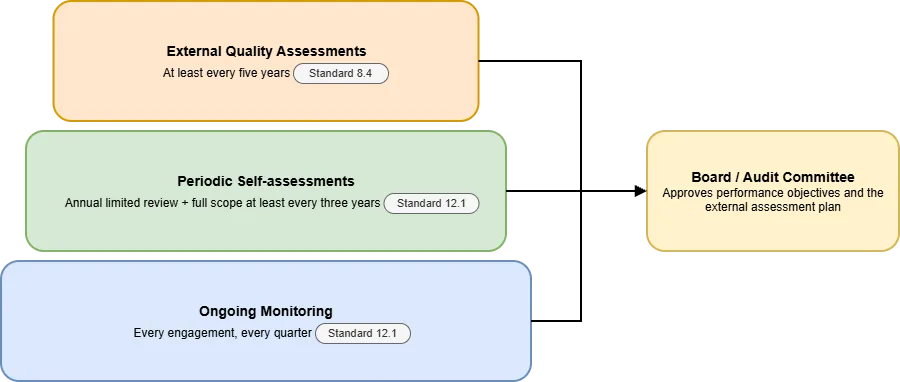
1. Ongoing Monitoring (every engagement, every quarter)
This is the foundation. Quality should be built into the work, not added onto it afterward. Ongoing monitoring includes:
- Engagement quality checklists signed by preparer and reviewer
- Documented supervisory review of planning, workpapers, and reports
- Workpapers detailed enough for an experienced auditor to reperform the work
- Post-engagement stakeholder surveys
- A quarterly KPI dashboard: plan completion, timeliness, budget versus actual, and issue aging
2. Periodic Self-Assessments (annual and full-scope)
Ongoing monitoring looks at individual engagements. Periodic self-assessments look at the whole function and test conformance with every Standard, including governance. They can be performed by the internal audit team or by others in the organization who know internal audit practices well enough to evaluate conformance. A leading practice is:
- Annually: a limited self-assessment covering a conformance checklist for all 15 Principles, a sample of completed engagements, KPI results, and the status of prior action plans
- At least every three years: a full-scope self-assessment across all Domains and Principles, including stakeholder interviews
Document internal assessments to the standard an external assessor would expect. Standard 12.1 requires them to be documented and included in the external assessor's evaluation, and a well-documented full-scope self-assessment can later support independent validation.
3. External Quality Assessment (at least every five years)
This must be performed by a qualified assessor from outside the organization who has no conflicts of interest. Present the plan, scope, and assessor qualifications to the board for approval. If you choose a self-assessment with independent validation, explain why. Arrange for the assessor to deliver the complete results directly to the board.
Recommended QAIP Document Layout
Use this outline to draft your QAIP. Most functions can produce a solid first version in 15 to 20 pages.
- Purpose and Objectives. Why the program exists. Define quality as conformance plus performance.
- Authoritative Basis and Scope. The Standards, your charter, and any laws or regulations relevant to internal auditing in your industry. Scope must cover all aspects of the function, including outsourced or co-sourced work.
- QAIP Framework. The three assessment layers, with a Plan-Do-Check-Act cycle for each.
- Roles and Responsibilities. Board or audit committee, CAE, senior management, engagement leaders, QA reviewers, and the external assessor.
- QAIP Universe and Annual QAIP Plan. Everything subject to review (engagements, key internal audit processes, methodology, governance, strategic initiatives) and the risk-based criteria for selecting each year's reviews.
- Ongoing Monitoring. Engagement-level and function-level activities, with the evidence each one produces.
- Periodic Self-Assessments. Frequency, scope, procedures, and reviewer requirements.
- External Quality Assessment. Timing, assessor qualifications, independence, and board approval.
- Performance Measurement. Performance objectives approved by the board each year, and the KPIs and targets used to measure them.
- Ratings, Findings, and Follow-Up. Conformance rating scale, finding severity ratings, and how findings are tracked, validated, and closed.
- Reporting and Communication. Who receives what, and when, including the annual QAIP report to the board.
- Conformance Statements and Disclosure. When you may claim conformance, and how nonconformance is disclosed.
- Documentation and Retention.
- Program Review. At least annually.
Useful appendices: an annual QAIP calendar, a gap register and action plan, an annual QAIP report template, the current year's QAIP plan, and an evidence inventory.
Types of Internal Reviews to Include
| Review type | Purpose |
|---|---|
| End-to-end file review | Assess a completed engagement for adherence to methodology and the Standards |
| In-flight review | Give real-time feedback before the report is issued |
| Peer review | Assess the reasonableness of judgments, scoping, and conclusions |
| Targeted or horizontal review | Test one attribute (such as sampling, issue validation, or risk assessment) across multiple engagements |
| Independence assessment | Test attestations, conflicts, and safeguards over any non-audit roles |
A Simple Rating Scale
Many functions use a four-level conformance scale:
- Fully Conforms
- Generally Conforms
- Partially Conforms
- Does Not Conform
Pair it with High, Medium, and Low severity ratings for individual findings. Validate High and Medium findings after remediation, ideally once enough time has passed to show the fix holds. If an external assessment is coming up, align your scale with the one in the IIA's current Quality Assessment Manual so internal and external results are comparable.
KPIs Worth Starting With
- Percentage of the approved audit plan completed
- Draft and final report turnaround time
- Engagements completed within budgeted hours
- Management action plans remediated by their due date
- Stakeholder survey results (value added, communication, report clarity)
- CPE compliance
- QAIP action plans closed on time
Keep the list short and measurable, and tie each KPI to a performance objective the board has approved. For formulas and more options, see 10 Audit KPIs Every Internal Audit Team Should Track.
Common Pitfalls
- Treating a self-assessment as an external assessment. A quality review performed by your own team, or by your outsourced internal audit provider, is an internal assessment. It does not satisfy Standard 8.4. An outsourced provider cannot independently assess or validate its own work.
- Assessing only part of the Standards. Self-assessments often focus on engagement execution (Domain V) and skip governance (Domain III). Board Essential Conditions, charter approval, and independence are where gaps are most common.
- No reviewer independence. QA reviewers should not have planned, performed, supervised, or reviewed the work they assess. A cooling-off period, often 12 months, is a good practice.
- CAE non-audit roles without safeguards. If the CAE also owns risk management, compliance, or another operational area, Standard 7.1 requires the responsibilities and safeguards to be documented in the charter. If those areas are subject to internal audit, an alternative source of assurance must be in place, such as an objective external provider that reports independently to the board.
- Small-function excuses. The Standards apply regardless of size. A one-person function will need outside help for an adequate QAIP.
- Legacy guidance. Much published QAIP guidance still refers to the 2017 IPPF (the 1300-series standards). It remains useful for leading practices, but map every reference to the Global Internal Audit Standards before you rely on it. The IIA publishes a two-way mapping between the 2017 and 2024 frameworks to help.
QAIP Quickstart Checklist
Governance and Foundation
- Downloaded the Global Internal Audit Standards and reviewed Principles 8 and 12
- Internal audit charter updated to the Global Internal Audit Standards, with a QAIP commitment and a five-year external assessment cycle
- Charter approved by the board, with the approval date documented
- Laws and regulations relevant to internal auditing in your industry identified
- CAE non-audit roles identified, with safeguards documented in the charter
Program Design
- QAIP document drafted, covering all aspects of the function
- Roles and responsibilities defined, including outsourced or co-sourced providers
- QAIP universe defined and an annual risk-based QAIP plan approved by the CAE
- QA reviewer independence and competency requirements documented
- Conformance rating scale and finding severity ratings defined
- QAIP action tracker created
Ongoing Monitoring
- Documented internal audit methodology in place
- Engagement templates: planning memo, work program, workpapers, report
- Engagement quality checklist with preparer and reviewer sign-off
- Workpaper and supervisory review standard (reperformance-ready)
- Documented sampling methodology
- Post-engagement stakeholder survey
- Issue tracker for management action plans
- Quarterly KPI dashboard
Performance Measurement
- Internal audit strategy documented
- Performance objectives, KPIs, and targets drafted with board and senior management input
- Performance objectives approved by the board (at least annually)
People
- Competency matrix covering required skills
- CPE tracker and annual training plan
- Annual independence and conflict-of-interest attestations
Periodic Self-Assessment
- Annual limited self-assessment scheduled
- Full-scope self-assessment (all Domains and Principles) completed at least every three years
- Results reported with ratings, findings, owners, and due dates
External Assessment
- Date of last external assessment confirmed (or "none" disclosed)
- External assessment plan presented to and approved by the board
- Independent, qualified assessor selected (at least one active CIA)
- Results communicated directly to the board
Reporting
- Annual QAIP report to the board covering conformance, performance objectives, regulatory compliance, and improvement plans
- Conformance wording in reports aligned with QAIP results
- Nonconformance disclosure process defined
- QAIP reviewed and updated at least annually
A Practical 90-Day Path
- Days 1–30: Assess. Download the Standards and run the IIA's Conformance Readiness Assessment Tool. Inventory your existing documents (charter, methodology, templates, board materials, prior assessments) against the checklist above. Document the gaps.
- Days 31–60: Design. Draft the QAIP document using the layout above. Draft performance objectives and KPIs. Update the charter. Build the engagement checklist, survey, and action tracker.
- Days 61–90: Approve and launch. Present the QAIP, performance objectives, updated charter, and external assessment plan to the audit committee. Start ongoing monitoring on the next engagement and schedule your first self-assessment.
A QAIP doesn't need to be elaborate to be effective. It needs to cover the whole function, produce evidence an assessor can rely on, and give the board a clear, annual view of conformance and performance.
When engagements, review sign-offs, findings, and action plans live in one GRC, SOX, and internal audit platform, much of that evidence is captured as the work happens. See how ControlHatch helps you run a quality internal audit function.